The Greensburg community can be proud of
the caliber of art that will be showcased by two of the city’s own artists,
Mark and Dorion Barill, father and son. Visitors to the exhibit will be treated
to “Rustbelt Romanticism,” a rich retrospective of their prominent works of
art. The pop-up exhibits at the Westmoreland Museum of American Art are
dedicated to recognizing the cultural contributions of our local artists and honoring
and celebrating their talents and achievements.
Background:
Mark is the art director for Phil Fraley
Productions, Inc. (www.philfraleyproductions.com.) He also has had extensive experience as a scenic
artist for film and television, notably The
John Adams Story, Wonderboys, and The
West Wing. Mark received formal art training at the California College of
the Arts in Oakland, California, and West Virginia University in Morgantown.
The artist’s paintings have been exhibited nationally and can often be seen at
the DV8 Expresso Bar & Gallery in Greensburg, which is owned and operated by
his wife Terrie.
Dorion Barill received formal arts and
design education at the Rhode Island School of Design in Providence, Rhode
Island. He has directed several
animation and film projects, including Allegory
of the Lizards (2012), Affresco Vivente (2009) and The Shadow (2006).
Both my father and I are intrigued
by those boundaries
between worlds we see and the hidden world of
memory and invention.
Our works lie along the division between
spaces past and dreamt.
--Dorion Barill
Q
Mark: Why Rustbelt Romanticism?
A:
Romanticism was an eighteenth
century art movement that emphasized strong emotional responses, especially in
relation to nature. “Rustbelt
Romanticism” is basically about the aesthetics of decay, but it is also about
growth . . . about what sprouts and thrives in the cracks of the concrete. When
I was a kid, old factories and abandoned buildings were our playgrounds—places
to explore and have adventures. When I grew older, I worked in a glass factory where
I developed a different perspective on that type of environment. About the time
I started college, the factories started shutting down all over the area, and I
saw its effect on the region in which I grew up. So, I have a very complex
emotional response for what remains of our industrial past. I think that’s a
pretty common experience in this area. In fact, I see a lot of art being
produced that focuses on that type of imagery. Anyway, we think the title is
apt for the exhibit, given the type of imagery that shows up in our work.

Q. Dorion: While
your father’s work deals with environments closer to home, yours seems to be
influenced by travels to more far-flung regions of the globe. What was the
calling to travel to such remote and exotic places?
A. A lot of my
work begins with drawing from observation – outdoors, underground, beautiful
places, abandoned places, museums – landscapes, in a vague sense of the
word. Whenever you draw from
observation, you build a unique relationship with the space because the process
is so complex and challenging. You might
stand there for hours imitating a mirror, with an academic curiosity of form
and light. But the real discoveries come
with the distortions – the intruding fictions – and you realize there is more
to a space than what is seen. My work
has taken me to many interesting and remote places because it’s a way of cultivating
fictions.
Q.
Dorion: So you have some of the
explorer in you?
A. Well, most
recently my partner, Christina, and I were working on an animation in
Cappadocia, central Turkey. The scenery
is otherworldly, a dreamscape of volcanic valleys and labyrinths of bizarre
rock formations. Whole cities and
painted monasteries have been carved out of the cliffs and towers of tuff. There are also underground “cities” that
delve hundreds of feet below the surface and extend for miles into the
desert. We were exploring one of these
cities, navigating some of the more rugged tunnels, about fourteen stories
down. We had to creep past one of the
massive stone wheels that the ancient defenders would roll into place to seal
off passageways. There wasn’t much space
to slip through, and we were a little apprehensive of being crushed or trapped. But it led to a wild and perhaps forgotten
zone.
There were real hazards
– endless ventilation shafts, crumbling support structures. And as we proceeded, the excavations became
more erratic: stairs leading into the ceiling, doorways leading to rooms in the
floor . . . as if the halls had been twisted.
We came to an expansive
space that glistened with dew and overlooked a precarious tangle of masonry
leading deeper into the city. We wanted
to leave. But at the far end of that
room – opposite the lower level of decayed stonework – I saw something
stretched across the floor. It stood out
so vividly, so pale. Surrounding it,
there was evidence of a cave-in. Piled
boulders and earth seemed to be blocking the entrance to another corridor. I remember approaching it and realizing what
it was: a pale skin stretched over the skeleton of a horse. A horse!
Fourteen stories underground!
These spaces – these
isolated spaces – exist on the boundary between the world we see and a hidden
world. To find these spaces—to explore
them—is a way of drawing the work out of that hidden world . . . a way to develop narratives and a means of
expanding the visual vocabulary.
Q. Mark:
What type of art do you make?
A. I’m a
painter and sculptor. My work has changed quite a bit over the years, but there
are certain threads that run throughout my work; stylistically they are
realistic, and there is usually a narrative involved . . . and that narrative
is often evocative of time.
Q. What works will be included in the exhibit at the
museum? What is the theme?
A.
There is no real theme, but we have common lines of inquiry. The show will be very diverse. I think what
this show is really about is evolution and change; it is about the evolution of
two artists—a father and son—over the course of time. It is also about how
being witness to my evolution influenced Dorion in his early years as he was
developing as an artist, and how Dorion has influenced me.
Q. Dorion:
How would you best describe what visitors can expect to see at the upcoming
showing at the museum?
A. My father and I are both intrigued by those
boundaries between worlds we see, and the hidden world of memory...and
invention. Our work lies along the
division, with spaces past and dreamt.
Certainly, we’ve been drawn to some of the same spaces – a particular
bridge, an old factory, a forest. It’ll
be interesting to see how that reflects in the work, to consider what concepts
we draw from these spaces. Are they
similar? Do they clash? A conversation develops between the pieces, at
times in harmony, in other times at odds.
Q. Mark: What
was a big influence on your painting?
A.
There have been many. When I was a child, I really knew nothing about art. Rather,
I grew up on a steady diet of comic books and pulp novels. When I entered
college, this whole new world opened up to me. Some of the artists that I
emulated in my earlier career were Robert Longo, Ed Kienholtz, Odd Nerdrum and,
of course, the old masters played a huge role in my development. But I did not
have access to much of their actual work, and that is the key to understanding.
Currently I am interested in the Hudson River School of Art, I have learned a
great deal about landscape painting by studying their work, but I don’t think
any of my paintings closely resembles that style or any other style. You have
to develop your own voice.
Q:
Dorion: Who have you studied
with whom you share a sense of purpose?
A.
When I was studying in Rome,
Piranesi became a hero of mine. He was
an eighteenth century Venetian printmaker, though he studied as an
architect. He is best known for his Carceri d’Invenzione, a series of
etchings inspired by the labyrinthine dungeons of the Eternal City. He produced thousands of plates in his
lifetime, romantically emphasizing the monumentality of Roman architecture. He also produced numerous maps, which were a
fascinating reference while I was trespassing all over subterranean Rome.
Q. Mark: What
is inspiring you now?
A. I’m interested in natural history, earth science,
our experience of time, how we interact with our environment—these are things
that I’ve always found fascinating. The big question for me is: How do I
represent concepts associated with these subjects in a meaningful way? I’ve
spent most of my career working with natural history museums, and that
continues to be a constant source of inspiration.
Q.
How has Dorion influenced your work?
A.
Our entire family is very creative. My wife, Terrie, is an artist and operator
of our family business, DV8 Espresso Bar & Gallery. My youngest son, Sean,
is a musician with an incredible amount of potential. At the dinner table we
discuss painters like other families discuss football players. Dorion grew up
in a very different environment than I did, and it shows. As well as being very
talented he is committed and hard working. The amount of energy, focus, and
commitment he puts into his work is inspiring. His critiques of my work have
always cut straight to the weak points of any piece that I happen to be working
on. He has a passion for art history and philosophy that parallels some of my own
interests, although he is much more studious; it leads to some very interesting
discussions. I think his biggest influence on me is that he does not allow me
to become lazy.
Q. Dorion: How
much of an influence has your father had on your art?
A. I grew up in a household where art-making was a way
of life. I’ve been getting art history
lessons since I was old enough to talk.
Being surrounded by works of art, immersed in museums, and fed a
never-ending supply of paint, clay, and pastels probably doomed me to the arts
by the age of five. And ever since, I’ve
been fortunate to have the encouragement and honesty of my father’s critiques.
I
remember hiking in the woods with my Dad, when I was a child. He’s always taken the trails less
traveled. We’d climb through thickets
and discover ruins of old factories, mines, railway stations. Those hikes had such an impact because they
awoke the explorer in me.
Gary Klinga is an
editor, writer, book reviewer and lover of art. He lives in Greensburg.


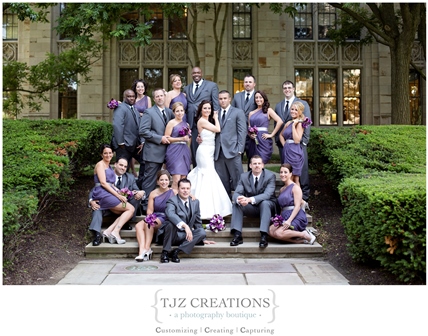
 TJZ Creations specializes in wedding photography, but
Tiffany does much more than take photographs on the wedding day. She strives to
create the perfect bridal experience for her clients; even helping to plan the
wedding, choosing a venue, dress shopping, and much more.
TJZ Creations specializes in wedding photography, but
Tiffany does much more than take photographs on the wedding day. She strives to
create the perfect bridal experience for her clients; even helping to plan the
wedding, choosing a venue, dress shopping, and much more.  “I want the bride and groom to have their wedding be an
experience. As their photographer, I want them to have special treatment,” said
Tiffany.
“I want the bride and groom to have their wedding be an
experience. As their photographer, I want them to have special treatment,” said
Tiffany.